
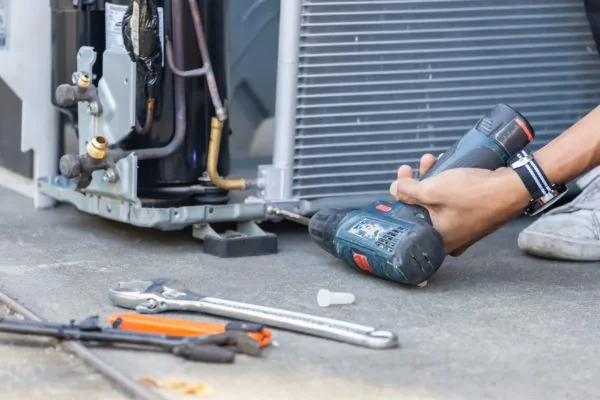
The Pump at the Center of Everything
Refrigerant only moves heat out of your house if something keeps it moving, and that something is the compressor. It lives inside the outdoor unit, sealed in a rounded steel shell, and it does two jobs at once: it pushes refrigerant around the loop, and it squeezes the returning vapor to the high pressure and temperature that let the outdoor coil release its heat. Everything else in the system depends on that squeeze. No compression, no cooling, no matter how healthy the rest of the equipment is.
Scroll Compressors and Why the Design Matters
Most modern residential systems use a scroll compressor: one spiral orbits inside another, sweeping refrigerant into a smaller and smaller pocket until it leaves compressed. Older reciprocating compressors did the same work with pistons and valves and far more moving parts. Fewer parts means fewer places to wear, which is why scroll units run smoother and quieter and tend to hold up longer. If your system was installed in the last decade or so, a scroll is almost certainly what’s in it.
Signs of Compressor Trouble
- It won’t start. The outdoor fan may spin while the compressor stays quiet, or the whole unit hums and gives up.
- The breaker trips. A compressor pulling too much current on startup takes the breaker with it, sometimes over and over.
- Grinding or screeching. Loud mechanical noise from the outdoor cabinet is metal in distress, and it doesn’t heal.
- Warm air indoors. A compressor that runs without building pressure moves no heat, so the vents blow room-temperature air.
One quiet compressor-killer deserves its own mention: a weak capacitor. It forces the compressor to strain through every start, and a season of that strain can wear out a motor that had years left in it. Techs call it hard starting, and it’s the reason a weak capacitor gets swapped on sight rather than watched.
The Repair-or-Replace Question
Here’s the part nobody enjoys. Because the compressor is the most expensive single component, its failure changes the math as equipment ages. On a newer unit, especially with the compressor under manufacturer warranty, repair is usually the right call. On a system that’s been sweating through Acadiana summers for twelve or fifteen years, installing the priciest part into a cabinet where the coils, fan motor, and wiring carry the same mileage often isn’t.
You don’t have to guess at it. Our repair or replace calculator runs the $5,000 Rule, the same rule of thumb we use in the field, weighing the repair quote against the system’s age. And if the answer leans toward a new system, our Louisiana AC replacement cost guide walks through what actually drives the price before anyone sets foot in your house.
DIY or Call a Pro?
There is no homeowner-serviceable side to a compressor. It’s a sealed component wired for high voltage and plumbed into a pressurized refrigerant loop, and diagnosing one takes gauges, meters, and a practiced ear. What you can do is protect it: keep the outdoor coil clean, change your filters, and treat humming, clicking, and breaker trips as messages instead of nuisances.
Caught early, a compressor problem is often still a part. Caught late, it’s a whole new system. That’s the whole argument for calling (337) 893-5646 at the first tripped breaker or strange new noise, or scheduling a repair before the weekend gets involved.