
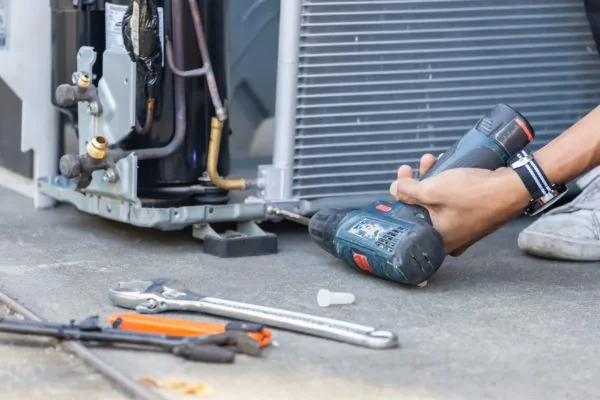
One Outdoor Unit, No Ducts
A central air system cools air in one place and pushes it through ductwork to every room. A mini split skips the middleman. Its outdoor unit does the same job as any condenser, but instead of feeding a duct system, it feeds refrigerant directly to indoor units mounted in the rooms themselves. The connection is a slim bundle of refrigerant lines and wiring that passes through a hole about the size of your fist, which is why most installations wrap up in a day.
The indoor unit is the part you live with: a low-profile cabinet high on the wall or recessed into the ceiling, with its own fan, coil, filter, and remote. Set one room to 68 for sleeping while the rest of the house holds 75. Nobody argues with the thermostat, because every zone has its own.
Where Mini Splits Shine
Some homes were simply never built for ducts, and plenty of Acadiana houses fall in that category: older places, camps, garage apartments. A mini split brings real air conditioning to them without carving up walls and ceilings for duct runs.
They’re also the answer for the spaces central systems leave behind. The addition the original system was never sized for. The garage workshop that’s unbearable by June. The upstairs room that runs hot no matter what the hallway thermostat says. One zone, one small hole, problem solved.
The Efficiency Story
Two things drive mini split efficiency. First, the equipment itself: these are inverter-driven systems that ramp their output up and down continuously instead of blasting on and off, the same variable-speed behavior found in premium central systems. Second, what they don’t have: ductwork. Every central system loses some cooling through its ducts, and ducts running through a hot Louisiana attic lose more than most. A mini split delivers its cooling directly into the room, with nothing lost in transit.
That’s how the ratings climb past 20 SEER2, and past 30 on some models, in a market where standard central equipment typically lands between 14 and 16.
Mini Split or Central System?
If your home has healthy ductwork, a central system usually remains the natural fit, and the two aren’t enemies: plenty of houses run central air for the main rooms and a mini split for the stubborn spot. If your home has no ducts at all, the comparison gets interesting in earnest, and zone-by-zone ductless can carry an entire house. The right answer depends on the floor plan, the budget, and how the rooms actually get used, which is exactly what an in-home consultation sorts out.
DIY or Call a Pro?
Online retailers will happily sell you a mini split in a box, and we’d still steer you to professional installation. The refrigerant connection has to be made, evacuated, and charged correctly or the system’s efficiency and lifespan quietly drain away, and handling refrigerant requires certification besides. Sizing matters just as much: a zone that’s too large short-cycles and leaves the room clammy, which defeats the reason you bought it.
We install and service Mitsubishi and Lennox ductless systems across Acadiana, from single-zone problem-solvers to whole-home setups. Curious whether one fits your situation? Start with our ductless mini split page or call (337) 893-5646 and describe the room; we’ll tell you what we’d do with it.